

From HarperPrism to NYT Bestseller(s)
By Jay Annelli
The HarperPrism Era
The year is 1994, Magic: The Gathering hasn’t even been around for a full year yet when Wizards of the Coast and HarperPrism (an imprint of megapublisher Harper Collins) sign a deal for official Magic: The Gathering fiction. The game is a blockbuster hit, but outside of a short story in the rules booklet, there’s little in the way of lore outside of the cards.
Time out real quick: what is an imprint? If you’re not familiar with publishing, an imprint is a division of a publisher that works on specific genres or types of media. It is (ideally) staffed with editors and marketers who are familiar with that side of the industry. It also tells the consumer what kind of books they can expect from that imprint. In HarperPrism’s case, it was HarperCollins’ science fiction, fantasy, and licensed media tie-in wing.
In October 1994, HarperPrism published Arena by William R. Forstchen, and it was a resounding success. Fall 1994’s issue of The Duelist features a single page excerpt from the novel as advertisement. It came with a special promo card. And there is currently a class of Magic player for whom this is still the definitive Magic story. The name ‘Arena’ becomes iconic in Magic parlance, with both a board game and the current digital client using the title. I didn’t like it very much, but I can see why it would be exciting to early fans.
Harper Prism released twelve Magic novels in just two years, a shocking volume of work for such a limited amount of time. Besides Arena, Clayton Emery’s Greensleeves trilogy (Whispering Woods, Shattered Chains, and Final Sacrifice) are really the only other books of note, remaining popular enough over the decades that both Garth One-Eye (the protagonist of Arena) and Greensleeves herself received cards almost 20 years later. The anthologies contained an iconic story or two (such as Distant Planes’ Chef's Surprise by Sonia Orin Lyris), but little else from this era has remained relevant.
These novels had the Magic: The Gathering Logo, but they largely read like generic fantasy, or D&D stories with the serial numbers filed off. There wasn’t yet a distinguishing element that said ‘this is a Magic story’. The first wave of novels likely had extremely tight turnarounds to write, print, and ship to stores. And during the time they were written, the franchise’s lore was mostly vague artwork on cards with no connective tissue. Personally, I’ve usually had as little as three months to write a first draft of one of my books, and my understanding is that’s pretty standard. Licensed fiction is infamous for tight margins and turnaround times.
At the time, Wizards hadn’t quite figured out what they wanted the story of Magic to be, and it was comics, not the novels, that would go on to define early Magic’s lore. Unfortunately, I don’t have time for a history of Magic comics here as well, but it often parallels the novels with similar ups and downs.
With the release of Dark Legacy at the tail end of 1996, HarperPrism’s contract ended. This isn’t particularly surprising, as these kinds of media deals are usually of a limited duration. A quick review of Magic comics publishing, for instance, shows that the license usually ends after about two years. But the end was coming for HarperPrism regardless, as Wizards of the Coast decided to shift from outsourcing to an internal creative and story team.
The Wizards of the Coast Era
A year and half after the HarperPrism novels ended, Wizards’ first self-published Magic novel was released: 1998’s The Brothers’ War (an adaptation of 1994’s set Antiquities). Wizards hired Jeff Grubb to write it, who was known for his years of contributions to D&D’s canon. Wizard’s debut novel continues to be a stand out in Magic’s own canon, with 2022’s The Brothers’ War set adapting Grubb’s vision of the war.
While it’s clear from multiple interviews over time that Wizards was determined to move forward with their own story plans, it’s not clear how much the acquisition of TSR in 1997 affected those plans. TSR had their own traditional publishing pipeline and stable of authors, including authors like Lynn Abbey and the returning Clayton Emery, who would go on to write for Wizards’ self-published series. Meanwhile, Wizards of the Coast hadn’t published anything larger than a quarterly magazine. The use of Jeff Grubb for their debut novel seems to indicate it was at least a consideration, although Magic’s paltry catalog of six-ish novels a year was nothing compared to the D&D publishing juggernaut.
Regardless, by 2002, Derek M. Buker asserts in his book on the publishing genre, Science Fiction and Fantasy Readers' Advisory: The Librarian's Guide to Cyborgs, Aliens, and Sorcerers that “A major portion of the fantasy paperbacks sold today are published by TSR, a subsidiary of Wizards of the Coast.” It’s not clear from the passage whether Derek meant by volume or sales (as only R.A. Salvatore seemed to be hitting the best sellers lists), but Magic was included in the list of titles.
The formula for Magic novels for the next four years was fairly consistent. Every set would have an accompanying novel (three per block), and then there would be a secondary line of novels, either an anthology book or a “side story” trilogy covering an earlier setting (like Legends or the Ice Age).
This appears to have been the apex of Magic’s publishing efforts, as Clayton Emery recalled his experience writing Johan, Jedit, and Hazezon in the early 2000’s on his website:
While there, I did get to ask, How do I graduate from the B list to the A list? "You don't." Will you guys promote my work? "No. If you catch fire with the fans, then we'll promote you." How do I catch fire with the fans if you don't promote my work? "Who knows? We don't promote Magic books as a rule anyway, because they don't sell well." Then why produce them? And hey, you promoted Jeff Grubb's latest Magic book, advertising it on the inside front cover of every DC comic for three months during one summer. "Oh, sure. His books sell." Well, am I at least guaranteed future work because of my loyalty and professionalism? "No. We can't guarantee anything." Such incentives can make a body dizzy.
Emery makes an excellent point that has frustrated Magic lore fans for decades. The novels don’t sell, so they don’t get promoted. But if they don’t get promoted, how could they sell more? It’s an awful Catch-22 that plagues the entire publishing industry today, not just Magic. The decline described by Emery was supported by later Creative Director Brady Dommermuth in his “Ask Brady” section on the old Mothership forums (helpfully archived here):
Q: I've been going through some very old archived information, and I found some statements from Storyline staff at the time (around 2000-2001) that the novel line was doing well, to the point where they were talking about publishing novels for Mirage, Homelands, The Dark and a whole slew of other stuff. Before it was finally cancelled, it was apparently doing pretty poorly. Out of curiosity, when did things start losing steam? Was it a gradual process, or was there a steep drop at some point? Any thoughts as to what might have happened?
A: That decade-old statement was... inaccurate. I'm sure it was rooted in optimism but it was not supported by data.
Part of this makes sense. The existing team wasn’t going to do anything but hype up plans for a product line they love. And without sales numbers we can’t say what the definition of ‘well’ was, but presumably they were at least paying for themselves. As of Champion’s Trial in 2003, however, the secondary line Magic novels (those side stories I mentioned) came to an end, and with it exited most of Magic’s author pool. The next five years of novels were buoyed almost entirely by authors Scott McGough and Cory J. Herndon, both of whom were current or former staff members at WotC.
What’s important to understand here, and what has been missing from many reflections on Magic publishing I’ve read over the years, is that this timeframe also marked a big change in the publishing industry. The digital age was upon us, and people weren’t reading as much as they had before. The entire publishing market began contracting, independent booksellers began going under, and by the late 00’s the writing was on the wall for even the massive book retailers like Borders. The 2008 recession just accelerated what was already happening.
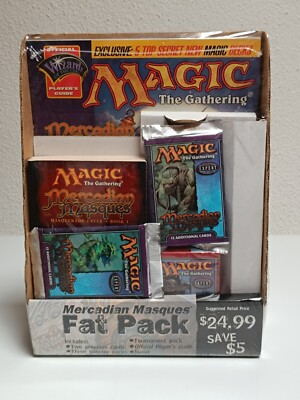
There’s another element worth discussing here as well. From 1999’s Mercadian Masques, Magic’s novels became a staple of Fat Packs (the predecessor of the modern day Bundle). Wizards has never (and will never) release the sales data, so it’s impossible to really say how well these novels were doing, but the abrupt decline in the mid-00’s indicates maybe not as well as the earlier novel team may have wanted you to think. Or, maybe just not as well as Wizards expected from their products, which is a different metric entirely.
Everything started to change in 2008. For the first time in a decade, the Shards of Alara Fat Pack didn’t include an accompanying novel. The novel line was reduced further from three a year to just two, the first being the plot of the entire three set block, and the other being “A Planeswalker novel”, a character-focused piece centered on Magic’s new mascots.
The quality of these novels dipped significantly over the years, with the worst being written under a pseudonym, “Robert Wintermute”. This new formula only lasted three years before the novels were quietly shelved entirely. The creative team attempted to keep things going with ebook novellas, written by internal team members for a couple years, but that gradually morphed into the Magic Story webfiction we still have today.
The cancellation of the novel line was only made official in a post from Brady Dommermuth on the Wizards forum a year later:
I didn't say anything because I wasn't cleared to do so. (I'm still not; nor is Mark.) Yes, the novels are on hiatus for now. They simply weren't doing well enough to justify their continued creation and publication. There are lots of data I'd love to share with you about the novels' performance historically and recently, as well as my own theories about why more people didn't buy them, but that information is all proprietary and I'm not permitted to divulge any of it, which I assure you is more frustrating to me than to you. I'll say this, though: By a very conservative estimate, 1 in 10,000 Magic players bought any given Magic novel. That's using the highest sales numbers among our books historically (not counting fat packs, which were priced in such a way as to make the book essentially free) and our lowest estimates of total Magic players. Given the meager profit margins on books, that's simply not enough sales to sustain that part of the business.
That second paragraph offers a really great insight into what a Magic novel’s sales were like, because the book market is so much smaller than you probably think. It continues to shock me how small the market is, and I’ve published a few books by now.
Just a couple years after this, Magic players were at an all-time high of 12 million, according to NBC News. Let’s say there was a theoretical Magic novel that year. Supposing that 1 in 10k figure was accurate, roughly speaking, that means only about 1,200 copies of that novel would have sold. Wizards usually charged $6.99 for a paperback. This is unusual because the standard in publishing is to release a hardcover first, with a paperback release half a year to a year later. This model is intended to recoup the budget on the hardcover and pick-up those extra customers who don’t want to pay $20+ for a novel later.
Because Wizards never really published hardcover editions (there were some, but it wasn’t standard), the paperback edition was their only product. Rounding that up that price to $7, that sales total means the novel would have only grossed around $8,400, with the lion’s share of that being the expense of the author and the printer. This does not include the indirect costs of employees (who always have other responsibilities) devoting their time to these novels, either.
While a mere 1,200 sales may seem like too small a number, the minimum threshold to debut as a New York Times Bestseller is currently around 5,000 to 10,000 copies in the first week. Until this week, the only Magic novel to reach the New York Times Bestseller list was 2019’s War of the Spark: Ravnica, so we know earlier Magic novels weren’t reaching those numbers. And these sales were being undercut by the functionally free book in Fat Packs, so it’s impossible to say what the actual readership of the time was, or if the books were subsidized by their relationship to the Fat Packs through some internal cost scheme..
This is a very rough approximation, and unless I’m missing something profound, I think we’re in the ballpark. It also gives you an idea of just how small the margins in publishing are. Most publishers defray those kinds of risks through diversification. They publish everything under the sun, and it all evens out. They lean on hardcover sales early, and only release cheaper paperback editions later.
Wizards only published Magic and D&D fantasy novels, and printed the Magic novels, at least, straight to paperback. And with the paperbacks being bundled into Fat Packs, they were practically giving them away the entire time (to this day, they’re the easiest out-of-print novels to find). And, it should be noted, that while D&D novels apparently did better than Magic, they too were subject to the same reductions in volume over the years.
The Del Rey Books Era
Thanks to the initial heroic efforts of Magic Creative Team member Jenna Helland, Magic’s story stayed afloat through web fiction (this was confirmed by Dommmermuth in the archive I posted earlier, where he credits the web fiction to Helland’s passion). Over time, it picked up steam enough to be worth exploring again alongside other media expressions. In the late 2010’s, Wizards created the Franchise Team, which was to handle external expressions of the brand. Wizards’ own self-publishing arm had mostly wound down by this point, and when the story changed hands with Dominaria (2018), the Franchise Team went looking for publishers willing to pick up the license. They eventually landed with Penguin Random House, under their Del Rey imprint.
This is when I started working with Wizards of the Coast as freelance Loremaster, specifically to work on the first novel, 2019’s New York Times Bestseller War of the Spark: Ravnica by Greg Weisman. I can’t talk about my behind-the-scenes knowledge of the book (not that I was privy to business decisions, anyway), but the perception of the War of the Spark novels among the fandom is complicated for a lot of reasons. Let me distill it into just a few.
The first is that the goal of the novel was muddled from the start. It was a big, epic conclusion to a years-in-the-making story, but it was also trying to be newcomer friendly. The switch from free webfiction to an expensive hardcover also predisposed a lot of fans of the webfiction against it. There was a negative undercurrent to the buzz for the book from the start (outlined in this older history by Sam Fatekeeper), and then almost the entire story of the novel was spoiled by card previews, a comic preview, and the cinematic trailer before the book’s release date. Needless to say, it did not live up to the community’s expectations, but being one of a handful of people to have read it without any of that? It was a middle of the road experience, it wasn’t the best Magic novel ever, but also not the worst (as some made it out to be).
Complicating the experience was the strange distribution method for Django Wexler’s The Gathering Storm, which was functionally the prequel novel for War of the Spark, but published after War of the Spark: Ravnica and divided into chapters delivered through a Del Rey newsletter. This meant that most readers of the novel were missing the context this story provided. And fans generally regard The Gathering Storm as the highlight of the War of the Spark era fiction.
And then came War of the Spark: Forsaken in 2019, a novel that would have been decidedly average had it not been for two confounding factors: the break-up of fan favorites Chandra and Nissa, and the implication that Chandra’s interest in women had all been a phase. The public reaction to that, combined with some other complicating factors, effectively ended the novel line again. Even if it had sold well, the buzz was so bad that it was making news headlines.
Two more e-novellas were released (The Wildered Quest by Kate Elliott and The Sundered Bond by Django Wexler), both excellent, but were overshadowed by the negative buzz in the community. By 2021’s Zendikar Rising, control of the story had been handed back from the Franchise Team to the Studio X Creative Team. Web fiction returned and novels were once more a thing of the past.
That is, until this year. 2026’s Strixhaven: Omens of Chaos by Seanan McGuire marks Magic’s new foray into traditional publishing. Wizards of the Coast is partnering with Penguin Random House again, this time with an eye on past mistakes. Omens of Chaos is a newcomer friendly novel, written by a veteran Magic author, whose appeal for existing fans is the deep worldbuilding, characterization, and exploration of new and legacy characters. One of those legacies is Kequia Akosa, the granddaughter of Teferi, who himself was the star of half a dozen earlier Magic novels.
So how do things look for Strixhaven: Omens of Chaos? While the Catch-22 Clayton Emery complained about twenty years ago is still true, McGuire launched a tireless one-woman pre-order campaign. The pre-orders exceeded expectations so much that the publishing team re-evaluated. The release date was pushed back to accommodate all the pre-orders, and to coincide with the hype for Secrets of Strixhaven. The book received an official website. Advanced Reader Copies were made available.
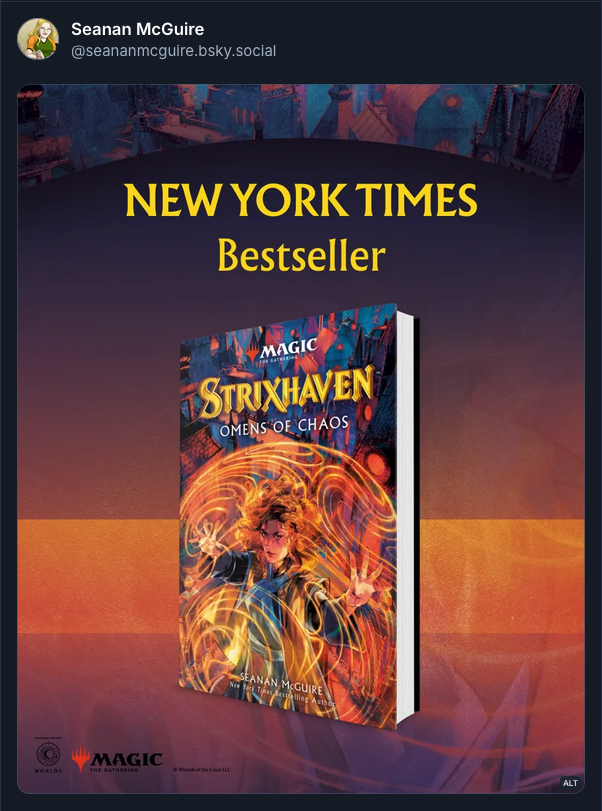
All that effort seems to have paid off, as Strixhaven: Omens of Chaos is a NYT Bestseller. While we don’t have exact sales numbers, this puts Omens way ahead of the pack, and shows the market for Magic novels exists. And that’s where we’re at. Do you want to see Magic novels return? Then the best course of action is to buy them. Get out there and get your copy of Strixhaven: Omens of Chaos now! Yes, this did turn into a little bit of a sales pitch. I’m not sorry about it. I don’t want to hear your complaints about the state of Magic fiction unless you’re putting your money where your mouth is.
Jay Annelli has been bad at playing Magic: the Gathering since 1998, and has no plans to change that. He's also been Magic's loremaster since 2018, and written several Magic: The Gathering art books including Magic: The Gathering—The Visual Guide.
In case you missed it yesterday, we now have a Discord for Subscribers! Hop on in!


