

By Rob Bockman
I’ve made some difficult picks in my two decades of drafting. I’ve passed a Lightning Bolt or two in various Masters sets drafts when I was firmly non-Red. I once opened a Time Spiral pack that had both Stronghold Overseer and Disintegrate. Hell, earlier this week I had to pick between Black Lotus and Booster Tutor during an Arena Cube draft, a closer pick than you’d think in that format.
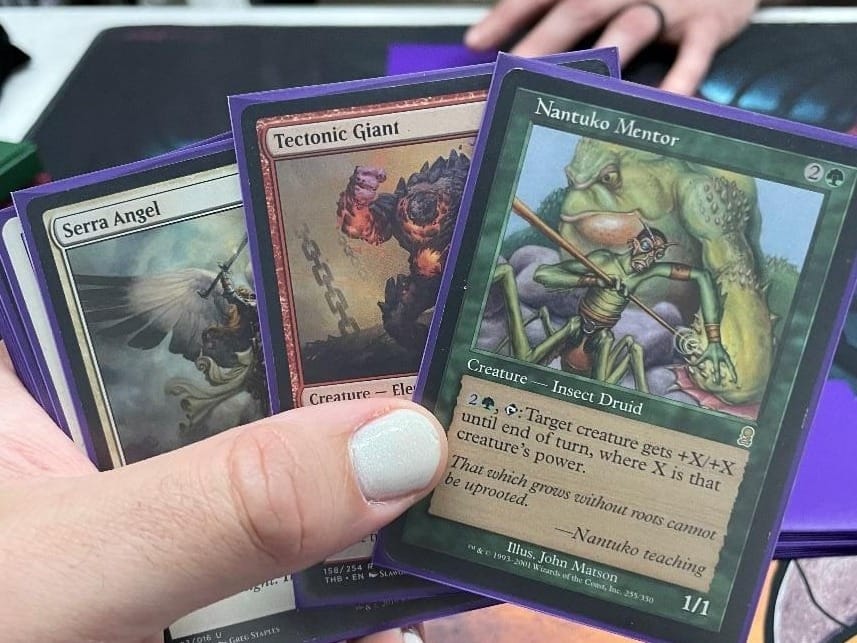
But on April 18th, 2026, I was faced with one of the toughest pack-one/pick-ones I’ve ever seen:
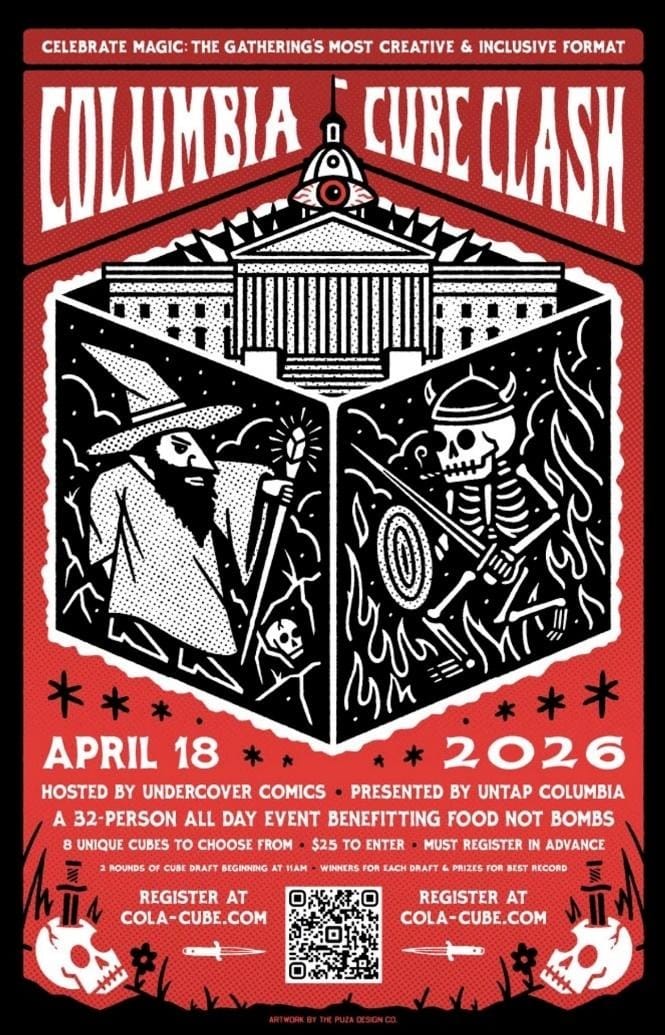
That’s not a pick anyone has ever had to make in Magic’s history, but I was drafting a Cube at the first Columbia Cube Clash, which was itself unprecedented. Hosted by a local play group at Columbia’s Underground Comics to benefit our city’s chapter of Food Not Bombs, the Cube Clash brought together 28 players and eight Cubes to jam games all day. It was very professional for a first-time event—local artist Nate Puza, who has designed tour posters for Phish, Dave Matthews Band, and Jason Isbell and in whose Jittery Joe’s can I keep my d20’s, produced the exceptional event poster, and the Cubes ran the gamut from fully powered to niche creations.
For my initial draft, I was sorted into a Starter Cube along with five other players. This was Hannah’s innovation, a welcoming Cube that recreated a Core Set environment with ample fixing, sorcery speed interaction, and big plays. The bombs were cards like Two-Headed Dragon and Siege-Gang Commander, and I won three games over the course of the morning by casting Enlarge on Pelakka Wurm. This was Magic streamlined, not simplified, and there was space for time-tested cards—my second-round opponent opened with Savannah Lions, which I outmatched with a Kird Ape. That was good enough in 1993, and it’s good enough more than three decades later. I went 6-0, but the games rarely felt imbalanced—I was just able to land a pump spell on one of my evasive beaters when they were tapped out.
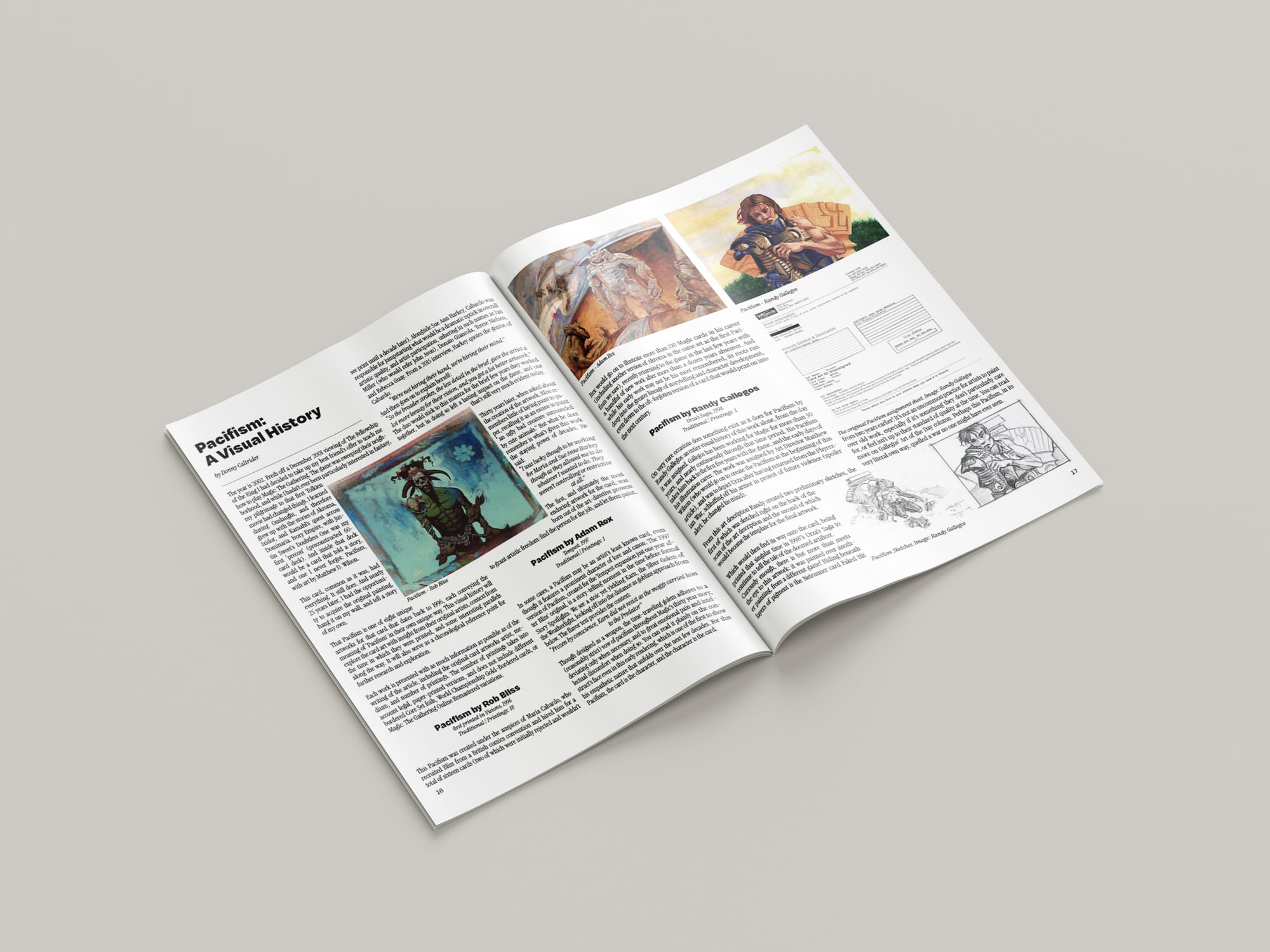
CASCADE CASCADE ISSUE 1 physical magaizine is on preorder through June 30th. Get it. :)
The second Cube I drafted that day was “Dirt & Bones,” a graveyard-themed Desert Cube. A Desert Cube is a long-standing Cube innovation where you must draft your lands out of your packs, meaning you give up relevant picks mid-draft to get the 16-17 lands you desperately need. It’s grueling—at one point, I picked a basic land over an Infernal Grasp and felt no compunctions over that pick, even with a Snapcaster Mage in my stack.
These matches were in stark contrast to my victories with the Starter Cube; I ended up 1-2 after grinding out some suitably brutal games. Zombies and Skeletons rushed in for one win, and I won another by casting and protecting the one-man-army that is Molten-Tail Masticore, before losing in turns on round two and getting completely run over in round three.
It was an interesting foil to the Starter Cube, like going from the Unitarian Church to a Latin Mass or going from high school makeout sessions to hardcore BDSM. I dropped games to my mana, most memorably to a more experienced Desert drafter who pivoted to drafting all the low-to-the-ground Boros beaters to punish those who relied on taplands and painlands, as I did. While I fiddled around in the graveyard, they burned me out.
As of June, if Wizards of the Coast shut down the printers and Mark Rosewater retired, with not a single card emerging out of Renton ever again, we’d still have over 32,000 existing cards. Cubes are commonly 360, 540, or 720 cards, and so even assuming that only 20,000 or so cards are theoretically playable, you could design a dozen Cubes without breaking a sweat. Parker Lamascus, Cube genius and evangelist, is a better source for the basics of Cube, but I do know how Cube feels and why it matters.
Just as every work of art has a political valence, every Cube has a philosophy behind it, even if its hidden or almost subconscious. Through Cube, we can learn what others prioritize and elevate. Some Cubes prioritize power, some playstyles, some nostalgia, some flavor. If you put 1,000 Magic players in a room with nothing but 360 sleeves and a printout of every card, you would get 1,000 different Cubes, which defines why, as some folks say, Cube will outlive Magic. When you create a Cube, you bring your preferences and personality (or to be less charitable, pathologies) to the table.
This is a Cube.
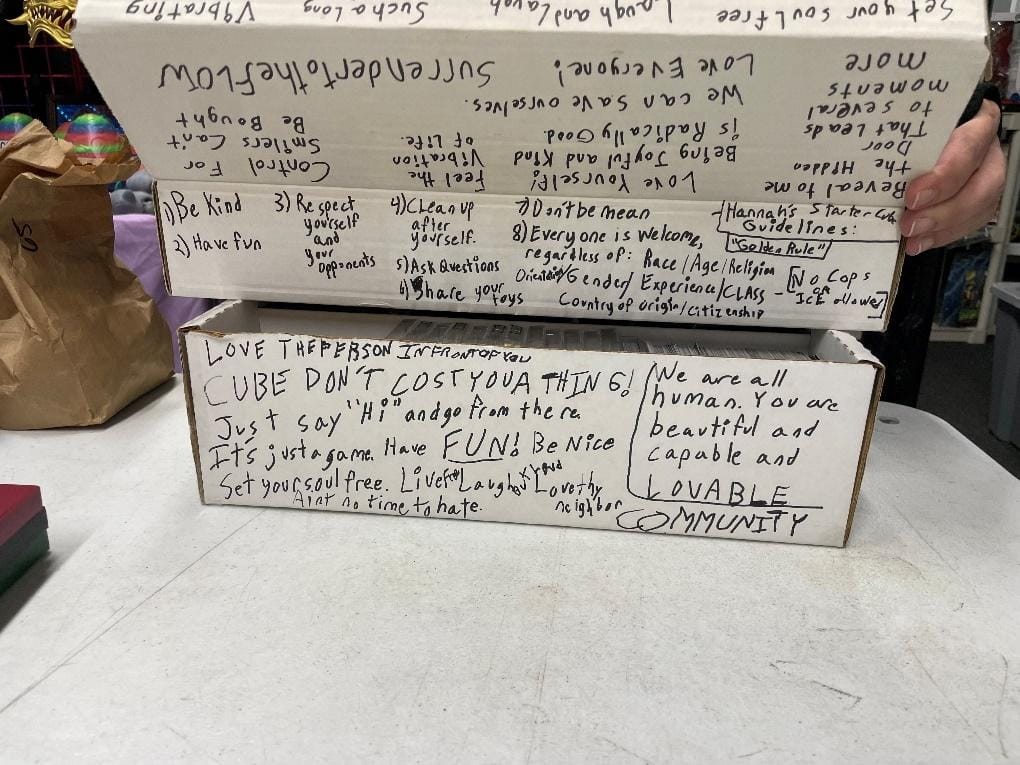
This is a Cube.
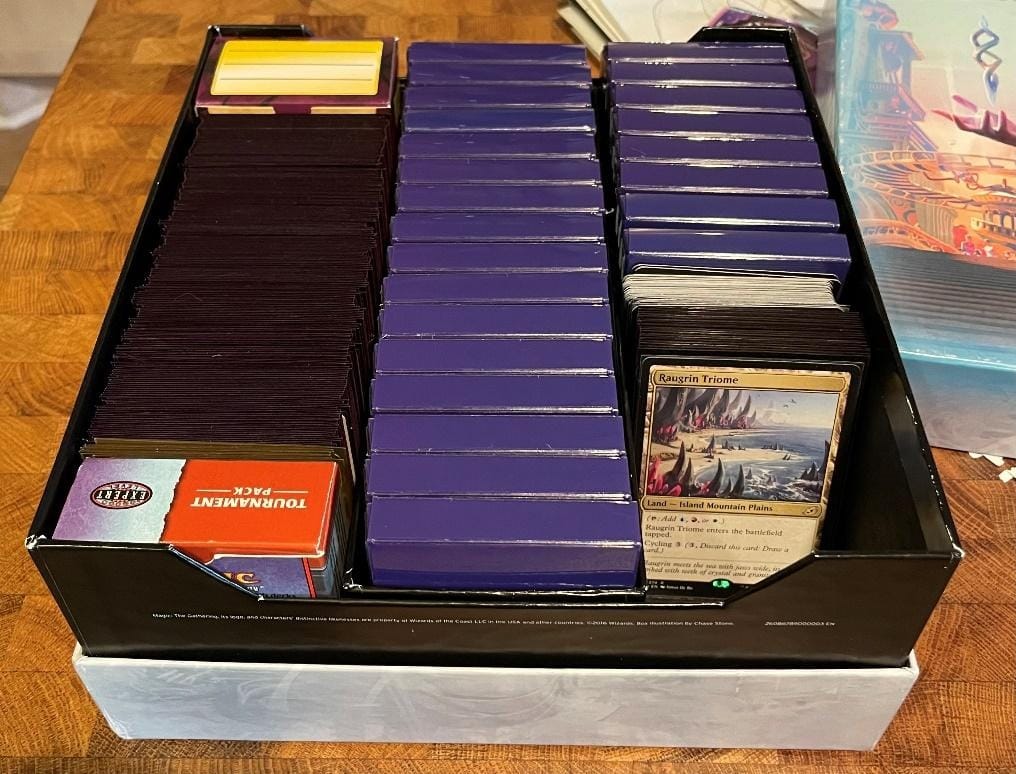
This, too, is a Cube.
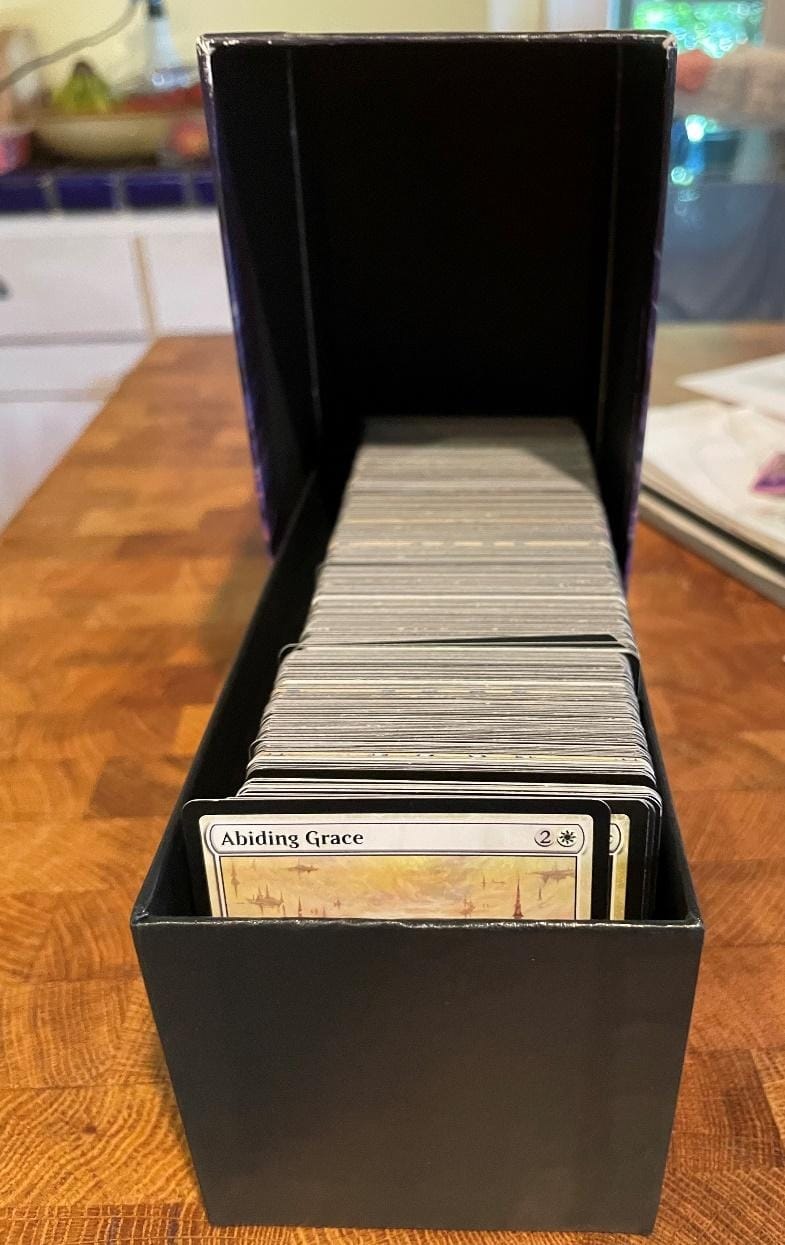
This is a Cube.
With Cube, you are in control of the experience. For a lot of enfranchised players, myself included, who feel that the Magic they knew is out of their control, it’s a way to recreate an environment or an experience they loved. For some people, that’s Premodern; for others, it’s pre-Modern Horizons Modern. Others may design Cubes that reward rules interactions or showcase their favorite artists or highlight the comedy of Magic—e.g., I’m very fond of my Archenemy Cube’s hidden archetype of “draft Lost in the Woods, draft Sapling Nursery, and add 38 Forests.” You can build a color-imbalanced Cube, a retro border Cube, a “decisions typal” Cube loaded with Fact or Fiction and Gifts Ungiven effects, or just a simple creatures and spells Cube.
If you’d like to build a Cube that is the worst cards of all time, where Ember Shot rubs elbows with Quagmire Lamprey, and Kangee, Aerie Keeper is a valuable threat, you can do that (as an aficionado of Crap Rare drafts in college, I wouldn’t recommend this—it’s fun once, but you’re basically reverse engineering Homelands). If you’d like to build a Cube for players who miss pre-Modern Horizons Modern, replete with Tarmogoyf and Huntmaster of the Fells and Splinter Twin and Snapcaster Mage, you can. Through Cube, you can relive the Standard dominance of Jace, the Mind Sculptor and Liliana of the Veil, or you can untap Time Vault with Voltaic Key.
There are hyper-engineered Cubes that have been drafted, honed, and playtested for thousands of hours until they are precise machines, like Carmen Handy’s Proliferate Cube. There are Cubes that are mutable and chaotic and that reward long-term Magic knowledge to the extent that it approaches Mental Magic. Standard Practice, for example, is an extremely fun Cube card, as is Jund ‘Em Out, but they require a profoundly enfranchised audience. There are Commander Cubes and Pauper Cubes and homebrew Cubes with custom cards. There is a Cube for you, even if you have only ever played Commander.
Cube is open ended, both in initial design and in evolution. You can build a creature type matters Cube where Mutable Explorer is a first pick or a graveyard Cube where every spell has added utility in the ‘yard between Flashback, Aftermath, Jump-Start, and Harmonize. There are creatureless Cubes, color-imbalanced Cubes, and Cubes that showcase certain sets or aesthetics. The first step in creating a Cube is to ask yourself: “What do I value in Magic?”
Building a Cube, even if you’re just combing through a few thousand abandoned cards and compiling them into a reasonable 360 list, is time-consuming. It’s also expensive—even your most basic 360 cube needs 500 sleeves. I have a solution: stop caring about value outside of the game and start caring about value in the game. I’m not suggesting you shuffle up Revised Power on a picnic table, but are you really going to worry about reselling the Ravenous Baloth that’s been in your “former Standard powerhouse” binder for 20 years? Face it: most of the cards you own now are going into the storage unit or the local library when you buy the farm.
Don’t let that happen. You can build a Cube right this second based on draft chaff that’s floating around your home. All your Wolf Cove Villagers and Bitter Triumphs and Fire Magics that you’ve opened or drafted can have a second life as 1/360th of your first Cube. The Tragedy Feaster that won you a match at the Secrets of Strixhaven Prerelease, the Galvanic Discharge that fueled a Green-Red Energy Pauper deck that the metagame outgrew, the chewed-up Detention Sphere that you’ve had since high school, all of them can be a valid early pick in your very own Cube.
You can buy $1,600 worth of top-tier cards like Orcish Bowmasters and Vivi Ornitier and $220 worth of sleeves and have a double-sleeved and Legacy-level Cube that’s the envy of your playgroup. You can also budget $.50 per card, raid your local games store’s land bin, and build an unsleeved Cube for under $200. Swords to Plowshares, Llanowar Elves, Lightning Bolt, Infernal Grasp, Isamaru, Hound of Konda, Ignoble Hierarch, Stock Up, the painlands—we kvetch a lot about the pace of reprints in Magic, but these are all iconic cards that have been reprinted so often that you can build a Cube for less than you’d spend on a box of Marvel’s Super Heroes.
Your Cube will also age with you and will become a sort of playable memoir. Maybe you bought a playset of Noble Hierarchs back in early 2018 at $75 a pop and now they sit in a binder or a 1000-count box. You can trade a copy in for six bucks cash or you can start a Cube, where she’s still a high pick. The reign of Tarmogoyf is long over in tournament Magic, but not for those who dream of getting a second trigger off their Pyrogoyf in Cube. The cards you once loved are still lovable in Cube.
As I close in on forty, all my friends are cutting down on their possessions. A friend, a literary type, was bragging to me last week about how she’s down to a single banker’s box of books and an e-reader. My vinyl collecting pals are liquidating their collections on Discogs and shamefacedly returning to .FLAC files. There’s a larger belief here, in the age of Wegovy and Depop, that consumption and collection is immoral, that excess is inherently decadence. I understand the impulse to cut down, to fight the psychic and physical weight of accrual. But humans are a curatorial species, and Magic players are even more so, and so I would gently encourage you to find the joy in the curation and see your self-definition in what you surround yourself with. The me that fantasizes about a Magic collection small enough to fit in a backpack is perhaps just as fleeting and foolish as the old me who used to fantasize about owning a playset of every card ever printed. The honest me, the man with a hoard of half-finished Cubes and a box of skeletons that my daughter loves to leaf through, is happier than either. Like my stacks of books, some of which haven’t been touched since I moved in 2016, they’re a stratified accounting of my personal development to that point.
During my day at Undercover Comics, I reminded myself of what I loved about Magic. Every time an opponent said “hang on, let me read that” when I cast Nantuko Mentor, every time I commiserated with the drafter at my elbow about taking a Brushland over a Nantuko Shade, every moment of downtime between matches where I flicked through the time-worn boxes of bulk rares, was a reminder of what Magic does best. A game without a community is a way to fill hours, but a community built around a game, which is a kind of shared language, is a society. Since Columbia Cube Clash, I’ve revisited all of my Cubes, making edits and adding in new favorites from the last three months of Magic, adding to my personal history with the game. The first edit I made, and one that has yielded benefits already, is adding a beat-up foil Nantuko Mentor to my unsleeved Bar Cube, where it will forever remind me of a Saturday I spent with new friends and old favorites. Cube will outlive Magic, which means it’ll outlive me, and one day, someone else will have that Nantuko Mentor. Perhaps it—and thus me, in some attenuated way—will even live in their own Cube.
Rob Bockman is a writer and long-time resident of the Carolinas. He has written about Magic since 2017 and has been a Golgari aficionado since before that had a canonical name. He has a background in comedy writing, Southern Gothic literature, and dramaturgy, all of which, weirdly enough, comes into play with his Magic writing.

