

by Parker LaMascus
“What’s the big deal? It’s Just A Game.”
A thought-terminating cliche stands athwart critical thinking and shouts “Stop!”. My entire personality is overthinking Magic, so though it hurts to admit, I can really sympathize with the underlying emotion of this particular conversation-killer. Its subtext goes something like, “stop criticizing me based on my choice of entertainment.” Or maybe it’s even simpler: “stop with The Discourse™ and let’s play some Magic already.”
I am deeply ambivalent towards The Discourse™, an insane mixture of wet-blanketry and groupthink and also, occasionally, miraculously, the best efforts of powerless consumers to exert some leverage on the world for the better. You can see how we got here, even in Magic. A Hasbro artist or a contractor or an executive is abusing their power, and in the absence of any real justice, we hop on Twitter and raise our voices, threatening to tank some share prices unless the corporation bucks up. As it should, this gets a lot of engagement, but humans aren’t the only ones who notice. For nearly a decade, the Almighty Algorithm has optimized the entire social media experience for that can’t-look-away feeling of righteous anger.
Inconveniently, the social media activity that we’ve come to call cancellation rarely works as intended. There’s a whole right-wing ecosystem – Truth Social, the manosphere, the Fox News cinematic universe – ready to catch those pushed out of polite society, as Naomi Klein argued in her book Doppelganger. Harvey Weinstein and Jeffrey Epstein are unicorns among cancellations for facing some actual consequences. The rest start crackpot podcasts and a boner-pill brand (or, worst of all, a wizarding world reboot).
The more likely outcome is what we’ve seen too often since November 2024: progressive-sounding language of inclusion and safety weaponized as a much more sinister kind of expulsion. During #MeToo, the American public wielded this language well, to discipline abusers and sex pests; the Right now uses a cynical parody of inclusion to suspend the civil liberties of our immigrant neighbors and transgender siblings and student protesters. As opposed as these phenomena may be politically, there is a smooth moral continuum between them, one that begins with pro-social enforcement of norms, but ends in self-righteous scapegoating.
Truth is, we’re all a little fucked up by social media, the doomscrolling pocket idols whose preferred offerings are our calm and our authentic connections. As Olúfẹ́mi Táíwò writes, shame can be a productive emotion, calling us to honor our better natures, but shame is meant for gently entreating our friends and neighbors, not mobbing the parasocial strangers who said something dumb an entire internet away. Social media throws this nuance into a blender alongside hyperreal genocide photos and birthday wishes from your grandma: one supersized The Discourse™ smoothie coming right up. And the real kicker is that some people – the kinda-racist politician, the company president with a foul sense of humor – deserve to get shamed online! But real-world abuses of power aren’t the same as the bad opinions of a complete nobody with a keyboard – nobodies like us and our Magic opinions. We’re left throwing stones from houses we refuse to recognize as glass, except tacitly, when we say “what’s the big deal? It’s just a game.”
This is the truth within the cliche. Magic is just a game. It’s shiny cardboard we buy as a way to connect with our friends, a way to feel clever and socially valued, and yes, maybe an escape from the horrors and tragedies of subsistence under capitalism. The cliche thus rejects the all-or-nothing framing of reactionary scapegoating, maybe even rejects the post-Columbine moral panic on games. No more shibboleths that can change at the whim of whoever holds cultural power (as we have seen them change since 2024), because the function of black-and-white morality tests imposed upon strangers is nothing less than social control. If playing the wrong game or watching the wrong movie is grounds for cancellation, then we’d all better line up, because the open secret is that the whole system is rotten. There’s no such thing as ethical consumption.
No Ethical Consumption Under Capitalism
Ah, yet another cliche, and perhaps the strongest possible statement of “what’s the big deal?” Everything Westerners buy is bloodstained to some degree, from the bananas grown over Guatemalan graves to the smartphone made by factory workers so immiserated that Tim Cook had to install suicide nets in Apple’s factories. There’s no winning, we might say, so why even try when it’s something as piddly as a game?
Another reason to refrain from censoring each other purely on the perceived moral value of what we consume. Ain’t none of us got a lick of solid ground to stand on. Nonetheless, we keep on throwing stones, and worse, we take No Ethical Consumption too far, past an expression of sympathetic solidarity into a shrug of apathetic despair. It has become a cry for help from a consumeristic nihilism. (Blink twice and buy a collector pack if you’re trapped.) In fact, it is the very same nihilism that fuels social media scapegoating: we are small and powerless consumers whose only form of political agency is by buying or boycotting whatever’s at the top of our feeds, and nothing else could possibly matter.
Hopeless as political/social change may seem, our despair only serves the ruling class of Rowling defenders and Epstein protectors. Everyday working folks have many other forms of political action available to us. It’s surprisingly simple, for example, to place a phone call to your elected representatives (and, bonus points, you get to vent some anger). Mutual aid directly helps our neighbors in need. Boycotts are more powerful with organized, clear demands, as we saw when Minnesotans pressured Target during the ICE crackdown, or in the Boycott Divest Sanction movement. Protest and other direct actions are more effective – and hopeful, and surprisingly calming – in the streets than they are in an internet void. And there’s always the creation and enjoyment of art.
Yes, art. Not art as status symbol, those elite performances and objects that get traded around like NFTs for the ultra-wealthy (although I confess that I love an art museum). I’m talking about our local sticker-artists, our craft nights with friends, or the out-of-tune song we sing with all our might. The book or movie or game that brings us solace or teaches us empathy, if we only take the time to look. Art gains its political power precisely because it is not “useful” or “productive” by our usual standards. We do something that only matters intrinsically, and the act reminds us that there exist systems of meaning beyond the mercenary, the selfish, and the tactical. Such art breaks the self-righteous, solipsistic, nihilistic cycle of shame as social control. Even games, even games like Magic, contain this artistic power. “Just a game” denies this liberatory potential, ceding the territory of meaning-making to more nefarious forces who do take art seriously – for all the wrong reasons.
Games Matter to Fascists, At Least
If D&D or Magic: the Gathering had existed in Nazi Germany, they surely would have been thrown onto the bonfires alongside other so-called degenerate art. The Party embraced two gaming subgenres, the historical wargame and baldfaced propaganda for young kids. In Playing Oppression, authors Flanagan and Jakobson unpack this disturbing dynamic, whose most striking example was a 1930s game called Juden Raus! (“Jews Out!”). Imagine a Monopoly-style colorful board, but the entire ruleset revolves around deporting Jews from an Aryan town. Fun for the whole family, and if that family complains to their local Party rep, he can always claim refuge with “what’s the big deal? It’s just a game.”
Fascist regimes treat games like they treat the rest of art, a synecdoche for loyalty and violence. The abuse of art and artists is a threat: fall in line, or you’re next. They targeted Bauhaus architecture, with its utopian-socialist aspirations. They targeted the gauzy expressionism of Vienna’s Secession movement, including Gustav Klimpt’s famous Kiss and the work of an elderly Alphonse Mucha. Nowadays, reactionary tech bros use generative AI to denigrate the work of anti-war visionaries like Miyazaki and Coppola, disempowering human artists in the process. The goal is the same, and, as it turns out, the method hasn’t changed much since the 1930s, either.
Once the Nazis had seized as much as they could, they hosted a mocking 1937 exhibition called “Degenerate Art.” Unlike most museum exhibits, this was primarily a showcase of the power and moral righteousness of the Nazi Party, of pure schadenfreude at those smug painters and sculptors who finally got what was coming to them. Served them right for being unionists, or foreign, or gay, or getting famous while the rest of Weimar Germany suffered under the Treaty of Versailles and the Depression. The violence embodied in these stolen galleries was Nazism’s entire theory of governance: maintain power by inventing new threats to beat up, protect the political interests of capital, and expand as far as racial and military might allows.
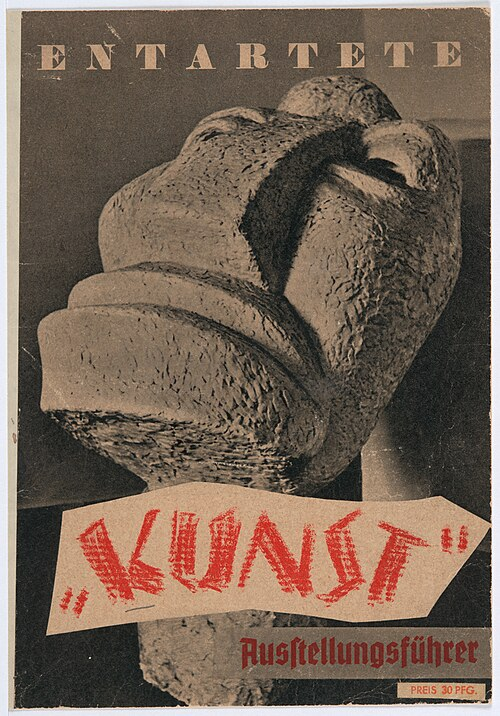
To be clear, I am not saying that cancel culture (Weinstein edition) is tantamount to fascist repression. Rather, the algorithm-fueled impulse to dogpile strangers online is the same reactionary scapegoating that fascists amplify to consolidate power, an impulse we’ve seen bear its ugly fruit since 2024. Gamergate was a form of this reactionary proto-fascism, using “journalistic ethics” as a thin progressive-sounding screen to shield its misogynistic backlash. When a game is designed by a woman, that art object should be treated as an all-or-nothing moral signifier that justifies doxxing, and threats. When a game is instead a retrograde patriarchal artifact, it’s “not a big deal” or “just a game.”
Reactionaries know that games matter, with our evidence being the energy they expend to influence gaming culture. The US military recruits teenagers by chatting in Call of Duty lobbies. Worse, far-right groups recruit lonely men by chatting about historical tank games. Military drones can be controlled with an Xbox handset, further blurring the lines between reality and fiction. Free-speech chuds defend reactionary media from cancellation while review-bombing projects that involve women. Games matter to fascists because fascists care about controlling art, and games are, unreservedly, art.
Games, the Art Form of Agency
Most of our daily decision-making sucks eggs. Where’s the best gas price? Which chore is most urgent? How can I find the budget for my car repairs? Roth IRA or meme stocks? What job should I apply for? We make hundreds of these decisions a week, with zero clarity or feedback or even any apparent purpose. Maybe I chose the cheapest gas pump, but it made me late for work and there’s a petro-war on, anyways, so did it even matter? It’s a miniature form of the agential aimlessness that fuels the “no ethical consumption” cliche, one that lives in the drudgery of tax deductions and grocery shopping and job-mandated LinkedIn posts. Games are the cure.
In his book, The Score, philosopher C. Thi Nguyen quotes Bernard Suits’ definition of games: the “voluntary acceptance of unnecessary obstacles.” If the goal of golf is to put a ball into a hole, it’d be simplest to pick up the ball and walk to the green, but instead we spend hours getting better at hitting the ball with a skinny metal stick. If the goal of Magic is to win a wizard’s duel, the easiest thing would be to sucker-punch our opponent in the face, or Sharpie ourselves a 20-damage Lightning Bolt, but instead we limit ourselves to settling things on the neoprene battlefield with officially designed cardboard. The obstacle is the point, because in games, unlike in the rest of life, we get to luxuriate in the joy of making fun decisions.
Nguyen claims in The Score that games are the art form of agency, the same way that music is the art form of listening, or dance is the art form of movement. Games are not “high culture” like cinema or opera, but a participatory democratic form of structured storytelling. Rules, goals, and scoring systems combine to jolt us out of quotidian decisionmaking into a transcendent flow of possibilities that are just at the limit of our reach. A perfectly sequenced combat step. A synergy that nobody else saw coming. A themed Vorthos deck, so that all your friends can see the kind of person you are by how you choose to play. The core appeal of games is that we can be the decision-makers, the agents, who get to choose for ourselves and for none other! This lovely outcome is only possible because games are something we opt into for fun, not something we’re forced into by the structures of political economy.
Gaming is a powerful artistic act because it directly addresses the aimless nihilism at the core of consumerism, at the core of the 2020s’ reactionary social media. Games aren’t the all-or-nothing moral signifiers that moralizing reactionaries make them out to be. But they do matter, because when we play with our decision-making, we practice the kind of creative agency that’s required for real political and social change.
When we let down our defensive cliches and play games as if they matter, we begin to uncouple our play from its capitalist surroundings, even reclaiming little corners of Magic: the Gathering. For example, we can homebrew a Cube, one of the only Magic formats truly free from profit motives. Or alter cards whose original artists abused their power (a friend of mine recently offered free de-TERFing alters at Minneapolis’ Shoebox, pro-social shaming I can get behind). Create proxies that refuse Magic’s usual framing of speculative, saleable assets. Pay as much attention to ludonarrative and political theme as to mechanical power level, like we see in every video by folks like Spice8Rack and Rhystic Studies. And, most of all, we can and should treat gameplay as the enjoyment of extraordinary decisionmaking.
Games are not a big deal. They’re just art, and that’s why they matter.
Parker LaMascus is the Philly-based editor of Lucky Paper, where he writes a column about Cube design, history, and community.


