

by Cary
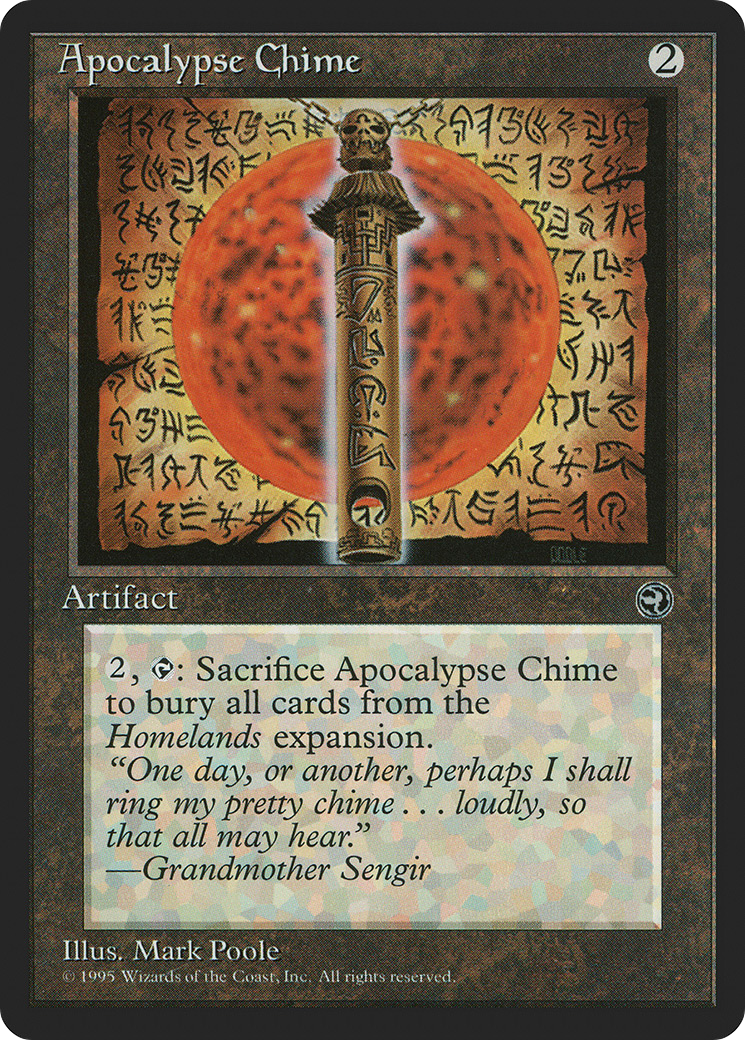
“Of course, there’s the Apocalypse Chime which costs 2 to cast, and 2 and tap to sacrifice to bury all Homelands cards in play. Another expansion sweeper. I thought WotC was going to stop making these. Oh well.”
—JonPKibble, The Library of Leng Issue #14
On their surface, expansion hosers appear to be the most archaic form of safety valve in the early evolution of Magic design. When spot removal and wraths weren’t enough to keep your head above water, targeting the greatest common factor was fully permitted, even if that ended up being as broad as a set symbol. The three expansion hosers that exist—City in a Bottle, Golgothian Sylex, and Apocalypse Chime—each have slight mechanical differences in execution, but send the same unnecessarily pointed message: Don’t play those fucking cards.


In May of 1994, Wizards rep Beth Moursund made the first real gameplay case for expansion hosers in a Q&A article from The Duelist Supplement, explaining, “these cards are a good reason not to depend too heavily on cards from one expansion.” Seemingly, this deckbuilding diversity concern would evaporate from within Wizards of the Coast shortly thereafter, resulting in their total absence from the sets Legends, The Dark, Fallen Empires, and Ice Age. The clunky design had become outdated, retired almost as quickly as it arrived—save for one oddball resurrection a year and a half later.
Since its inception in April 1994, amidst Scott Hungerford and Kyle Namvar sorting Antiquities cards for Kyle’s customer service reference binders, Homelands was dreamt to be something of a unifying backstory for the standout elements of Magic. Disparate lore from the first year of sets had offered up proper nouns like “Serra” and “Sengir” as blank canvases, primed with player curiosity. Simultaneously, newer names like “Urza” and “Mishra” and “Tocasia” had been anchored by a smattering of key details, but their tales remained severely underexplored. Weaving together story elements from Magic’s default setting of Dominaria would beget yet another Dominarian expansion. As has been the case for countless aspirational franchise entries, the allure of filling in gaps left by previous creatives was simply too strong.
Homelands does not take place on the plane of Dominaria though. During a particularly fateful backstory review for the set in November 1994, the designer duo of Hungerford and Namvar realized that they had missed out on reading two final pages of the published Antiquities fiction from that same issue of The Duelist Supplement. The triviality of this error did no favors to a story and expansion which had been attempting to dance around the continuity of ongoing Magic releases. Following a series of frantic rewrites, the setting of Homelands was shunted to a brand new plane in the Multiverse: Ulgrotha would become Magic’s first otherworld to be visited in a dedicated card set.
“Having Homelands established on a remote plane meant we could play with a lot of concepts without violating any of Dominaria’s core continuity, but we could still pull on theme and flavor as we liked due to the planeswalkers summoning creatures and heroes from all over the universe to fight their battles.” Hungerford answered in an interview last October, marking the 30th anniversary of Homelands. “We were able to refocus and refine the core themes of the set in a way where we weren’t fettered to the existing cultures of Dominaria. Looking back, it was kind of a lucky stroke, as I think that shift made the storyline even better.”
On top of the world itself changing beneath them, the constant stream of revisions demanded by a more rigorous development process wore on the green designer duo. This new process—which had only been afforded by way of Fallen Empires taking the set’s originally scheduled release slot—had intended to involve the original designers more as it moved through the final stages of review and tuning. By the end of extension, Namvar estimated that 75 cards were cut from Homelands and Hungerford recounted a baffling final day wherein R&D demanded 30 cards needed to be “redone” four hours before the set’s deadline.
Curiously, Apocalypse Chime survived through it all, and with it the threads of inspiration spanning between Antiquities and Homelands had begun to loop back. Because if you wanted to preserve much of the original Dominarian environment of a war-torn world, substituting Urza and Mishra’s armies with those of the mysterious Tolgath and Ancients seems obvious. The Hurloon could become the Anaba, legends could take on new identities, everything was flexible. However, you’d reach a dead end when reinterpreting the iconic finale of the Brothers’ War, as such a scene was nowhere to be found in Kathy Ice’s original fiction nor the creative card text of Antiquities.
The flavor of expansion sweepers hadn’t been long or storied. Richard Garfield’s design for City in the Bottle was a top-down concept pulled from Sandman, though Arabian Nights as a whole had no intentions of establishing multiversal canon. Golgothian Sylex was an unknown relic left carrying an awkwardly biblical title. From a narrative perspective, the Apocalypse Chime of Homelands would prove to be anything but loreless: It was a key weapon wielded by the Planeswalker Ravi, having been gifted to her by a Tolgath mentor. When she rang the chime, desperately seeking an end to the Ancient-Tolgath bloodshed, a colorless fire engulfed Ulgrotha and brought the plane to ruin. Magic’s first fantasy bomb had been born.
Three years later, in the flourishing kick-off to a new saga, the Chime’s predecessor would finally receive a turn under the story spotlight. The Brothers’ War novelization would imbue the Sylex with a familiar story relevance and power. With its activation, Urza ended his war with Mishra, laid waste to Terisiare, and ushered in the Ice Age. Dominaria and Ulgrotha, tangled in causality, would forever be twins born from sweeping devastation.
Enchant World
“Over time, the strengths of Homelands will surface in unpredictable ways as it becomes more and more a part of the growing multiverse of Dominia.”
—Christopher Ferris, Musings Magic Special #1
Within a year of release, the consensus surrounding Homelands had cemented into its final form: While the cards weren’t powerful, the flavor, setting, and story were good.
The sets prior had been something of a story wasteland by today’s standards. Legendary creatures, characters who would come to buoy much of the storytelling weight in card form, remained a relatively new and underexplored design option, with only three appearing in Ice Age. Supporting fiction had expanded beyond short magazine articles thanks to licensed comics and books, however both mediums proved to favor original stories over the limitations imposed by more direct set adaptations.
That said, pretending the bar was merely so low that story fans would cheer for anything would be a disservice to Hungerford and Namvar’s creative vision. They were enthusiastic worldbuilders who strived for Ulgrotha to feel like a complete, interconnected setting across card and page alike. From the top level inspirations of Alpha to the roster of monocolor legends and lieutenants, down to creative logic justifying individual card mechanics, every fragment of Homelands held a story, and a new game began with the distribution of those pieces to would-be story fans.
A concurrent comic release in the Homelands comic book illustrated the backstory and also granted the designers a dozen pages at the end for commentary, favorite cards, and miscellaneous Ulgrothan worldbuilding. In The Duelist magazine, a new flavor column titled From the Library of Leng would spin up in time with the set to share story insight on the legendary power players of the plane. Even as the spotlight moved back to Dominaria, Magic calendars and retrospective interviews continued to reveal more behind-the-card lore tidbits fit to print.
As the rise of online forums eased the sharing of storyline information, Homelands would retain its strong reputational momentum and allure for newer fans. It had been one of the first Magic settings developed with enough recorded depth that early archivists favored it, assembling a pre-wiki dossier to fuel discussions and fanfiction alike. As community interest in the wider Multiverse grew, a fan lorekeeper went to the source requesting more, and they received a sizable answer. I asked Hungerford what led to that moment.
“I’d been going through my hardcopy files from the period trying to figure out what to keep and what to toss, when the archivist got a hold of me asking about the storyline. After so many years, it seemed like releasing a rough document that dealt with a lot of secondary material would be interesting for the fans, to show how we got there.
“A big thing for me is that I think like a novelist, so when I write a book, I usually have hundreds of pages of material that gets set aside so I can make the core 80,000 words shine. In some ways Homelands was no different as we had to carefully pick and choose what story elements we wanted to show in the flavor text and the other printed materials. All the rest of the pieces would be set aside into a larger continuity doc, as we didn’t want to deluge the audience with too much information.”
The Homelands Document, as it came to be called upon circulation in story forums, was a behemoth clocking in at over 28,000 words. While the internal draft nature holds the document back in a gray area of canonicity—usurped in certain details by other published sources, and informally treated as sole canon for all others—its existence as Magic’s first true world guide negates any comparison to other sets of the era, as well as most in the story-driven decade that followed. To top it all off, the dozens of worldbuilding descriptions littering the document established a relatively complete card-by-card backstory encyclopedia for Homelands.
There’s something endearing about that much meticulous thought being put into every card of a set, and something equally absurd in taking the unsustainable step beyond modern Planeswalker’s Guides and Legends articles. It becomes the realized pipe dream of every story novice who posts online asking for the lore behind a piece of mundane draft chaff that caught their eye. Whether it was Giant Oyster or Willow Priestess, Ulgrotha had miraculously been born rich enough that there would always be secrets waiting to be discovered just beneath the surface of every card. That could be the promise of Magic, just this once.
Enter SENGIR
“A master of darkness, one who grows stronger from the blood of opponents and holds the power of life and death over vampire legions, the Baron’s just plain evil. (And if he isn’t the coolest-looking legend on the plane, we don’t know who is.)”
—InQuest staff, Home Sweet Home
Even among that keystone trinity of inspirations in Serra Angel, Hurloon Minotaur, and Sengir Vampire, the Baron prevailed.
While the first era of Magic’s fiction proved too infatuated with Richard Garfield’s original premise of Planeswalker duels and creatures summoned across planes, Sengir’s story indulged in pushing the idea to its extreme conclusion. He was an immortal vampire abandoned on the plane after his summoner was defeated in a duel and fled. Not one quick to die or be forgotten, it’s only fitting that the struggling world of Ulgrotha would be the home that Sengir de facto inherits, sharing in a history of scorn by Planeswalkers.
The Homelands comic book, illustrated by Rebecca Guay and authored by D.G. Chichester, eternalized Sengir’s presence from a background position. Even when the Planeswalkers Serra and Feroz meet with him and defiantly announce their plans to tip the scales of the plane out of his favor, Sengir knows that he needs to do little but wait. Death will inevitably come for everyone else, Planeswalker or not. I caught up with D.G. Chichester this past November and picked his brain on Sengir’s role on the plane.
“In the re-read and trying on that skin again I think he’s a force of nature that is a necessary balance—a presence at odds with our ‘heroes’ but someone/something that represents a larger cycle. When I’m writing a character like that, I’m not going ‘Oh, he’s the BAD guy.’ I’m putting on his motivations and giving those equal voice. (Otherwise you’re ‘taking sides’ and you may as well write from a soapbox.) And I think that richness is part and parcel of the whole Magic world.”
The final page of the comic leaves Sengir in somber triumph, visiting Feroz’s grave to pay his respects to the Planeswalker and plant a tree upon the site. As the protective barrier surrounding Ulgrotha began to fade upon Feroz’s death, more visitors would inevitably discover the Homelands. They would carry equally short-lived dreams of conquest, no different from the warlords of long ago or the naive usurper beneath the Baron’s feet. Ulgrotha already had a steward. It did not need another.
Included with every sealed copy of the comic were one of three rare Homelands cards: Apocalypse Chime, Feroz’s Ban, and Baron Sengir. A suite of story spotlights encapsulating each era of Ulgrotha, although the victor was once again clear as ever.
In fleshing out one of the iconic names of early Magic with a worthy progenitor, Homelands happened upon a classic. Wizards recognized as much and had the foresight to include a first-of-its-kind perforated print of Baron Sengir’s card artwork inside the corresponding release of The Duelist magazine. How many of those had been torn out and lovingly taped up on bedroom walls? Unfortunately, I missed the boat. My first taste didn’t come until much later (nearly the halfway point in Sengir legacy) by way of M12’s Elixir of Immortality, found in a 75-cent uncommon bin after school.
Still, I root for the underdog all the same. Three decades later and discussions of the game’s greatest storyline villains rarely go without a rogue recognition of the Baron into a churning sea of Bolas, Emrakul, and Yawgmoth replies. A throwaway vote, maybe, but his Alpha lineage gives him a claim to being the first. Hungerford spared a few thoughts on the staying power of Sengir.
“For me, Baron Sengir, apart from having some great card mechanics and being Pete [Venters]’s signature art piece for the set, the vampire lord just resonated with the audience. He had ties into every part of the world and had some seriously crazy family members backing him up. When you got a bunch of those into play together, that combined sense of awe and threat really worked for me as a designer. Urzatron was awesome... but when the whole Sengir clan came to call along with Ihsan's Shade? That was a thematically amazing moment.”
As of an update in Commander Legends, expanding on a momentary glimpse from the Future Sight set novel, the Baron has allegedly achieved his goal of leading an undead army through the planar portal below Castle Sengir, exiting Ulgrotha. It’s an off-screen development and I caution it should be taken only as such. There is simply too much of the world in the man for a departure to be believed, and Magic’s storytelling has walked back greater narrative missteps before in service of a return.
Perhaps that modern option is the dream though: To once and for all leave behind the tangled, historied plane of Ulgrotha. Free the legendary Baron with a one-way trip to a new world, crafted with a narrower identity that’s more palatable in the eyes of designers and fans. You could also excise my brain and try to place it in a different body. Some things are better off whole.
Cary is a Magic writer and archivist from the Great Lakes region. They can be found running laps in the park, taking a brisk walk downtown, or wherever you hear planar decks being shuffled.