

by Parker LaMascus
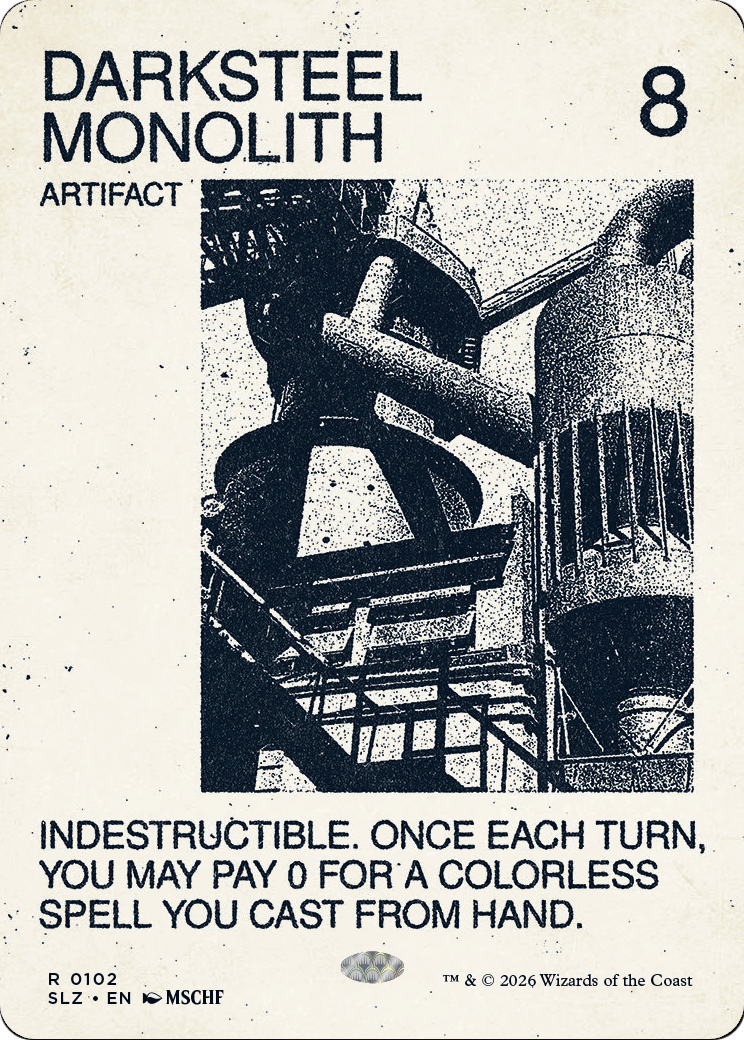
[[Darksteel Monolith]]'s newest printing is a first for Magic, featuring as its art a famous photo from pre-war America. Charles Sheeler was born and raised in Philly, where he trained as a painter, but turned to photography to pay the bills. In 1927, Sheeler visited the Ford auto plant on the River Rouge, near Detroit, and snapped a striking series of industrial landscapes, empty conveyors fragmenting the compositions into Cubist-like chunks of metal and concrete. Among the surreal, megalaphobic infrastructure, there is no glimpse of humanity. For a glorified ad meant to immortalize corporate power, I find Sheeler’s Ford Plant, River Rouge, Blast Furnace and Dust Catcher remarkably, rebelliously quiet. This year, thanks to MSCHF's Zeta set, I can hold Sheeler's photo in my hand, and it can cast my artifacts for free, too. The contrast between Sheeler's desolate photo and the power fantasy of an 8-mana Monolith evokes, to me, Shelley's "Ozymandias."
"Look on my works, ye mighty, and despair," Henry Ford might have said in 1927, but now his Detroit plant is the buckle of the Rust Belt – so too might such a [[Shattering Blow]] come for the mighty Monolith.
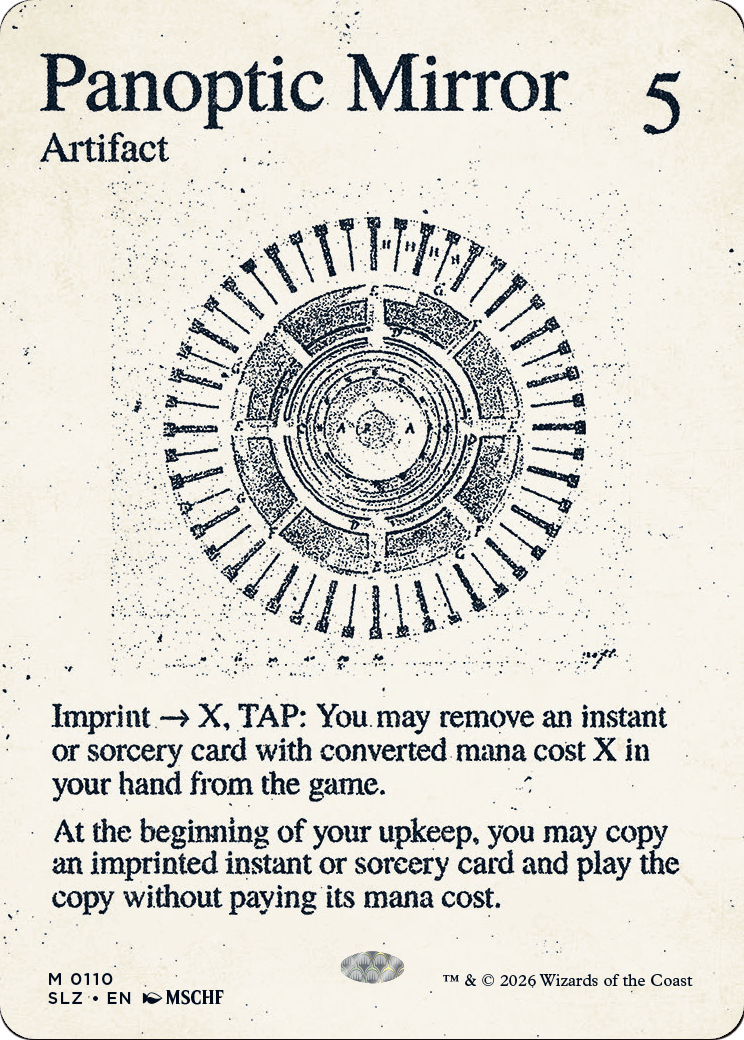
Because Sheeler lives rent-free in my head, Blast Furnace and Dust Catcher was the first artwork I clocked, but Zeta reinterprets extant art in nearly every card, it seems. [[Panoptic Mirror]] depicts Jeremy Bentham's Panopticon, the infamous school/prison design where one warden can observe every inmate without being visible themselves. The inmates will never know if authority's eye falls upon them, and so will self-regulate positive social behavior.
That's how Bentham's theory went, at least, but nowadays we're more familiar with dystopic panopticons like Sauron's Eye, Sauron's Palantir, Thiel's Palantir, Waymo, and Flock. MSCHF describes themselves as "a multidisciplinary artist group... that develops elaborate inventions that expose and leverage the absurdity of our cultural, political, and monetary systems." If Panoptic Mirror is an example of that, sign me up for more!, I thought.
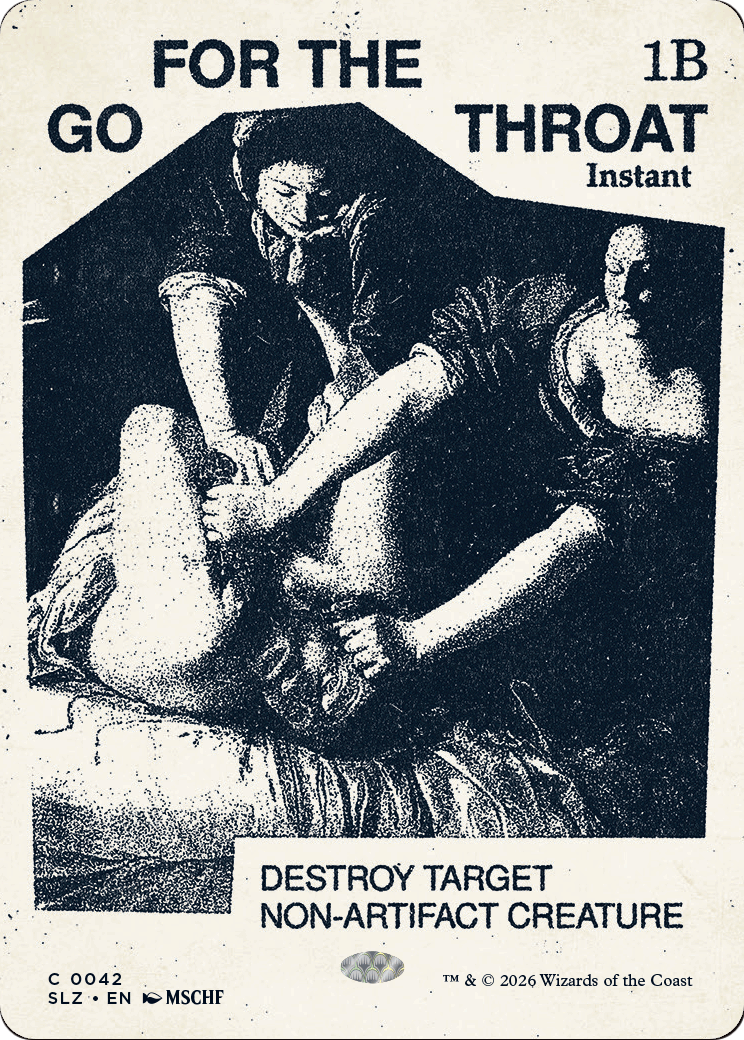
Another example: Artemisia Gentileschi's Judith Slaying Holofernes, winkingly quoted on Zeta's [[Go For The Throat]]. This classic Baroque painting retells a biblical story wherein an Israelite widow seduces an invading general, gets him stupid drunk, and chops off his head while he sleeps. Hell yeah, and Gentileschi's depiction is all the more special because a badass woman painted a badass woman, for money, in Catholic Italy. The only shame is that Judith hangs in the Uffizi Gallery in Florence, so it's not exactly democratically accessible. Here, on [[Go For The Throat]], everyone can appreciate Judith and its visible collage elements, reminders of how cool art can be in a new context when it is liberated outside a museum.
Scrolling idly through the Zeta spoiler, I spotted several Western etchings and woodblock illustrations, though I can't tell Doré from Durer. Two or three Japanese ukiyo-e prints. Dolly the sheep. Shots from Nosferatu (1922) and A Trip to the Moon (1902). A James McNeill Whistler painting. An illustration from War of the Worlds. A 1911 political cartoon from an IWW magazine, "The Pyramid of Capitalist System," itself derived from a 1901 Russian cartoon, is reproduced once again on MSCHF's Command Tower. (The socialist captions of the poster have been removed.)
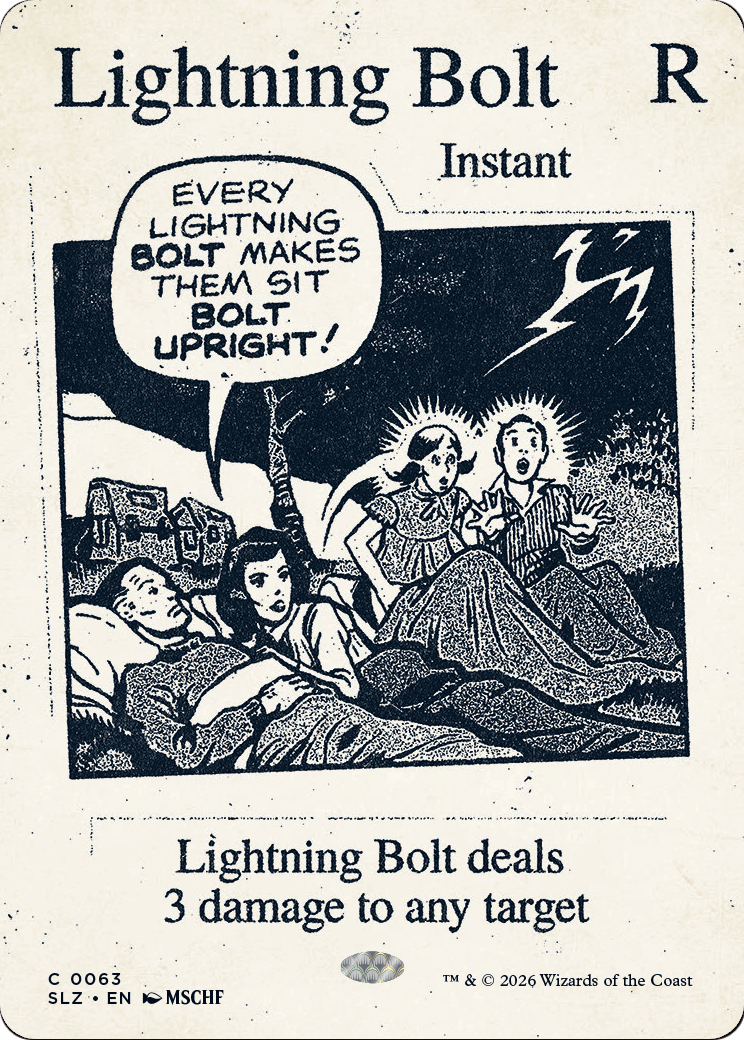
Then came Zeta's Lightning Bolt. When I saw the comic panel, I perked up -- could this be one of the Roy Lichtenstein Pop Art satires that I so adore? Or, failing that, a reference to some obscure Silver Age superhero camp? I eagerly googled the speech bubble, only to find a single relevant link, leading me to Wikimedia Commons. Wikipedia is a global treasure, not least because they archive high-quality public domain images. Every image on Wiki is available for free reuse under Creative Commons. This nameless comic panel is one example, released to the public domain by the textbook publisher Pearson. Within Wikipedia, the image is a reference in the German- and Japanese-language Wiki pages for "speech bubble" and other similar pages. It is not a famous comic, nor a Lichtenstein painting, nor anything else you'd recognize.
A creator's works pass into public domain 60 years after their death (barring any corporate-necromantic shenanigans). Charles Sheeler died in 1965, 61 years ago. Bentham and Gentileschi have been dead for centuries. Pearson Textbooks didn't care to monetize their Lightning Bolt panel. Click, goes the last puzzle piece. Look on my works, ye mighty, and reuse freely without the need for attribution or royalties.

Enjoying reading this free article on CASCADE CASCADE? Consider subscribing & supporting our ongoing work to keep writing about Magic alive.
Magic didn't commit any wrongdoing by not citing the original artists, because MSCHF sidestepped the copyright issues entirely by using 100% public domain images. MSCHF describes their approach as "Cultural Readymades," "celebrat[ing] the collaged construction and appropriated images of cards... xeroxed and taped together from the materials their creators had on hand." Well, I've lived in Philly for nearly a decade, played Magic at the student center and pizza parlor where Richard Garfield playtested thirty years before. Lemme tell ya, these spaces aren't full of public-domain Baroque art prints – they're plastered with logos and ads and registered trademarks, things that a broke PhD student can trivially reuse but a billion-dollar corporation cannot.
I almost respect MSCHF's boldness here. Reinterpreting "fine art" in a modern context is awesome. Half of creation is reuse, after all -- Gentileschi's Judith takes inspiration from the Baroque master Caravaggio, and Whistler's portrait evokes earlier works by Rembrandt and Vermeer. Art shouldn't be hoarded in elite museums, static and unchanging. Art ought to be brought into the streets, celebrated as an expression of our humanity, taught as something that anybody can do regardless of "skill." MSCHF knows this, it seems, but wants to have its cake too, playing nicely by the rules of corporate copyright while pretending they're not. If celebrating "Cultural Readymades" is the goal, then where are the Zeta sendups of the Hamburglar, Steamboat Willie, Cybertrucks, or Coca-Cola? If you're gonna satirize consumer culture with your edgy collages, then commit to the fucking bit, sellouts!
Everything about Zeta's handmade aesthetic turns out to be illusory. The charming cyan and yellow ink-smears are '90s nostalgia-bait, printed to micrometer precision on the best industrial equipment of 2026. Likewise the deep-fried copy-of-a-copy visual static. Inconsistent fonts and rules templating like "summon merfolk" and "Enchant creature/land/planeswalker" evoke an innocent carefreeness, like you're playing on schoolyard asphalt in elementary school, but the only people who can afford Zeta are adults with incomes to match. Tying all the punk DIY elements together, an anti-counterfeit holostamp proclaims that Zeta is 100% Official Faux-Handmade Cardboard.
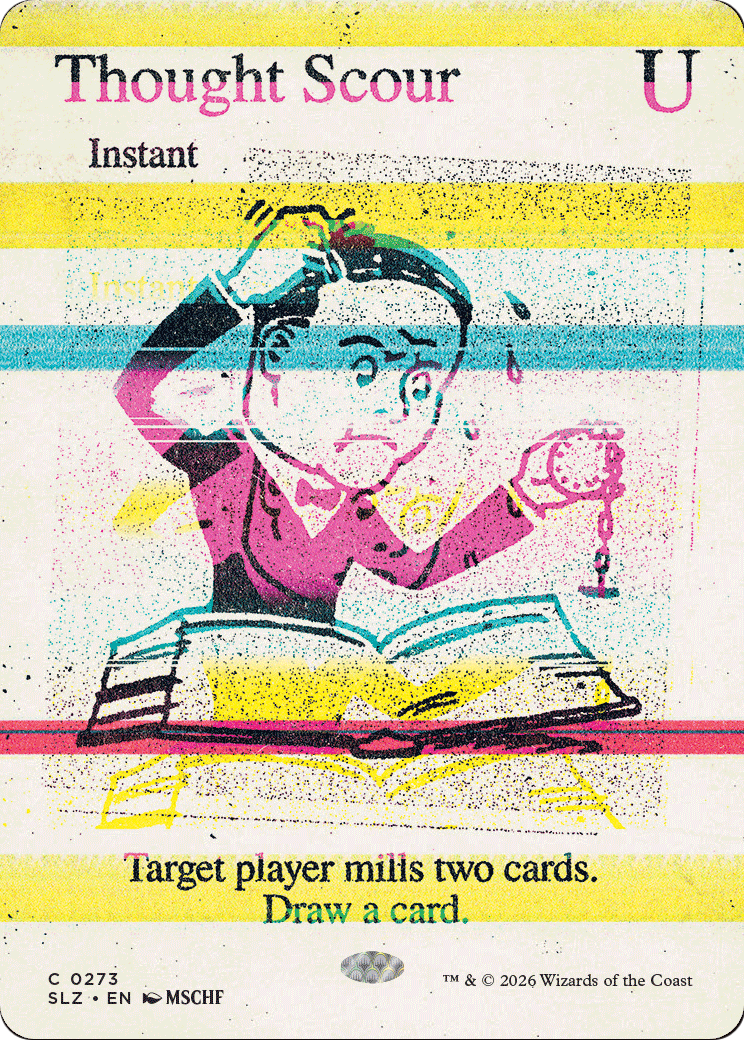
In the Zeta Set, MSCHF says the quiet part out loud. From Commander to DanDan, alters to proxies, Magic's Secret Lair sells fans' creativity back to us as exclusive objects of consumption. We are supposed to value the radical appropriation of Zeta's art, yet dutifully queue up to buy those images on officially-stamped cardboard randomized into speculative booster packs. Maybe this was MSCHF's real artistic statement, a big meta-joke to expose the "absurdity of our cultural, political, and monetary systems.” I honestly wouldn't be surprised if Zeta is MSCHF’s joke at our expense (and at Hasbro’s, too, given the utter “disaster” of the product’s bug-riddled rollout). But I ultimately agree with the video essayist Spice8Rack, who quipped that Zeta is a Hot Topic punk jacket with pre-sewn anarchy symbols. It's corny, it's manipulative, and worst of all it's hypocritical.
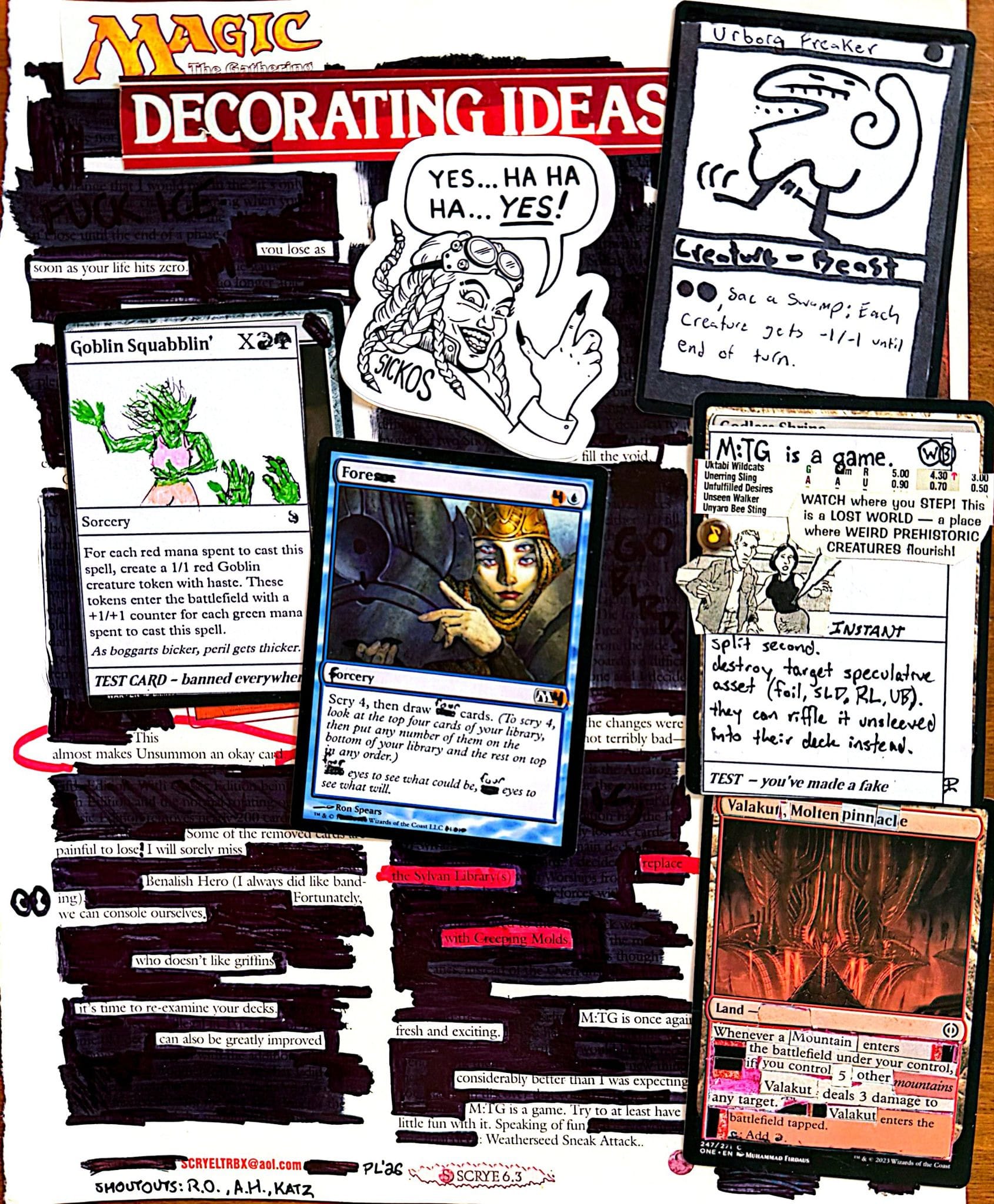
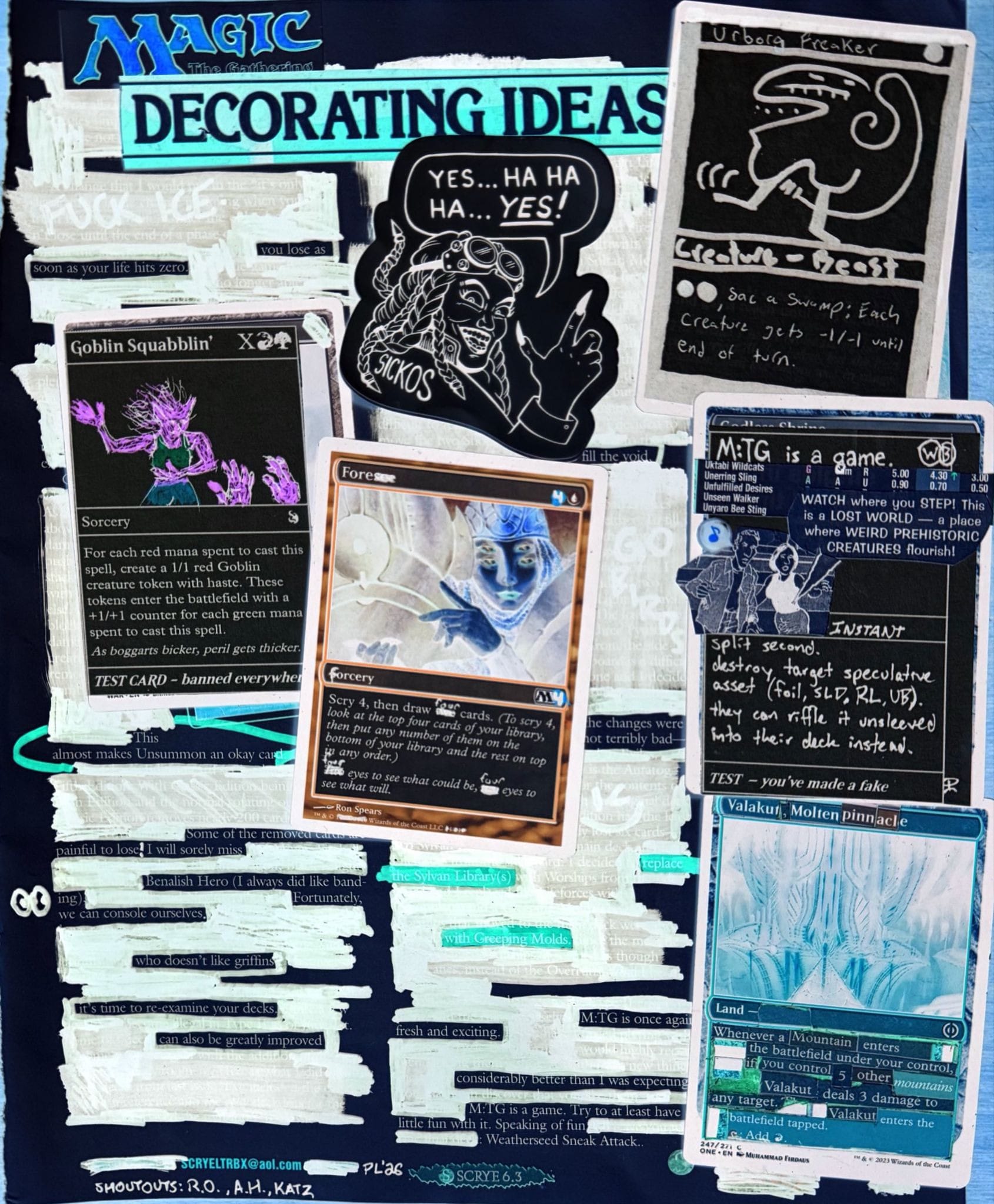
I love a collage party. Friends sitting around a table with snacks, a vinyl on quietly enough for conversation, scissors and gluesticks in hand like it's recess, extracting soulless corporate art and glossy advertising into delightfully irreverent new contexts. I even threw a few bulk Magic cards into my bin of materials, which make perfect fodder for friends' birthday cards. Handmade things are the best gifts. When I receive one, there are always imperfections, but those are my favorite parts. Wabi sabi: naturally flawed beauty. The flaws tell me that somebody cared about me enough to try something new, cared enough to make it with their own two hands and their finite time, and cared more about me than their own ego or sense of perfectionism.
The Zeta Set is mass-produced wabi sabi. Don't buy this poser shit. Find an old magazine and a gluestick instead. Find a Sharpie and some USPS shipping labels (free stickers). Have some friends over, put on some music, make some art that celebrates human ingenuity. Give zero shits about copyright. Photocopy it to give to your friends, photocopy the copies, again and again, and eventually you'll have your very own Zeta set. It will cost nothing, and unlike the official Zeta, yours might actually stand for something.
Here's some inspiration for your journey. Happy collaging.
Parker LaMascus is the Philly-based editor of Lucky Paper, where he writes a column about Cube design, history, and community.


.jpg?ref=cascadecascade.com)